What Are TDU Delivery Charges?

Delivery charges pay for the local grid that brings electricity to your home or business. See what they cover, how they're calculated, and why they can change. 

Rates are regulated and tied to your service location. 

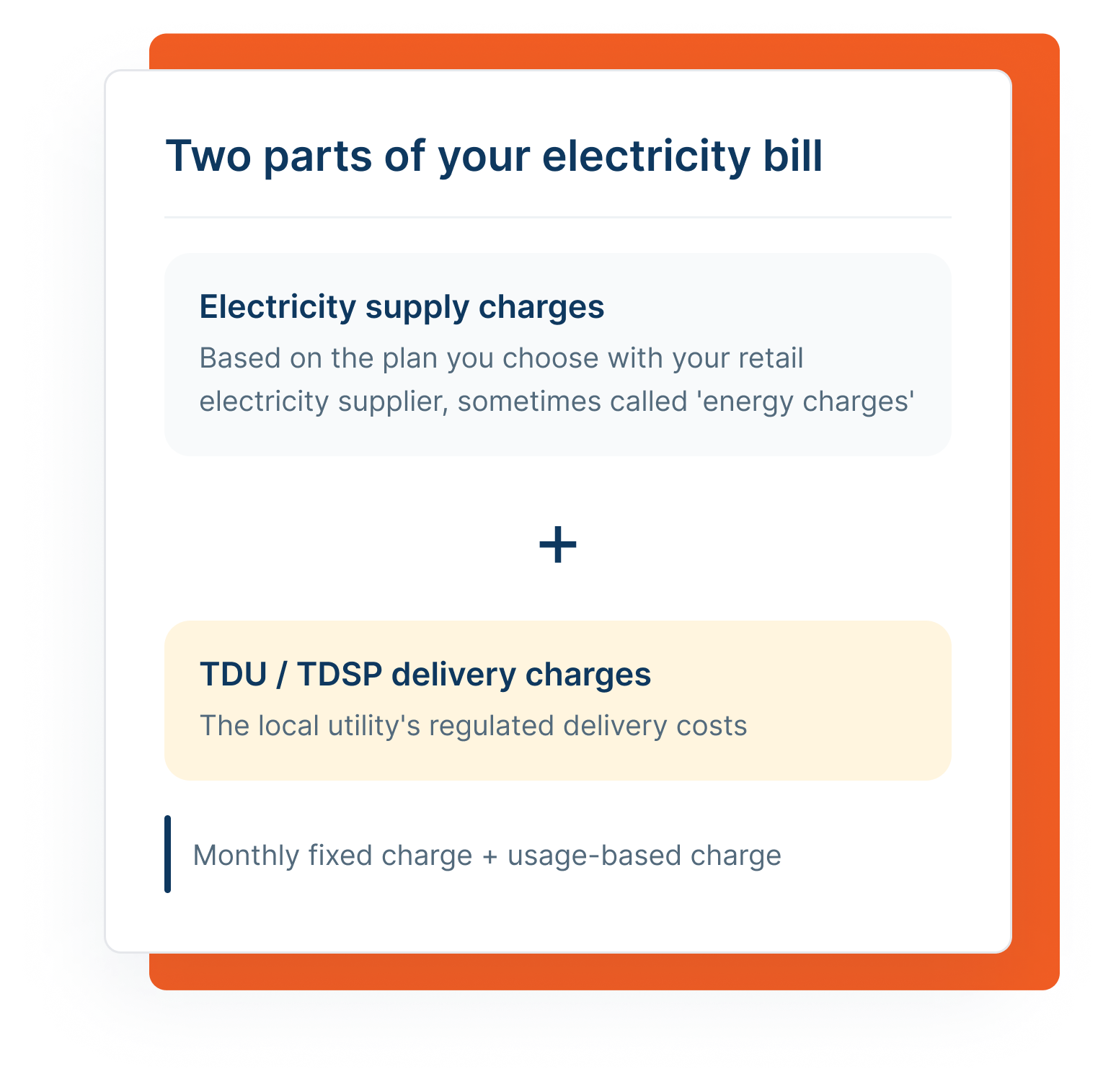
Two parts of your electricity bill
APG&E Sunset Wave

What are TDU Charges on My Electricity Bill? 

TDU charges are fees from your local Transmission and Distribution Utility (TDU) for delivering electricity to your home or business. You’ll see them on your APG&E bill alongside your energy charges. (TDU charges are sometimes also called TDSP charges.)

Power is delivered

Your utility maintains the poles, wires, meters, and equipment that move electricity across the local grid. 

Assigned by location

Your utility is based on your service address. Unlike a retail electricity provider, it isn't a company you choose. 


Rates are regulated

Customers in the same utility territory and rate class pay the same approved delivery rates with any retailer. 


How Does Electricity Get To Your Home or Business?

Ever wonder how electricity reaches you? Explore the three key stages of electricity generation, transmission, and distribution to better understand how power travels through the grid to your home or business.

STEP 1


Generation

Power plants produce electricity and send it onto the grid that serves your area.

STEP 2


TDU / TDSP

Your local utility delivers electricity from the grid to your service location.

STEP 3


Energy Usage

Your meter tracks how much electricity you use in kilowatt-hours (kWh) each month.

What Makes Up Your TDU Delivery Charges?

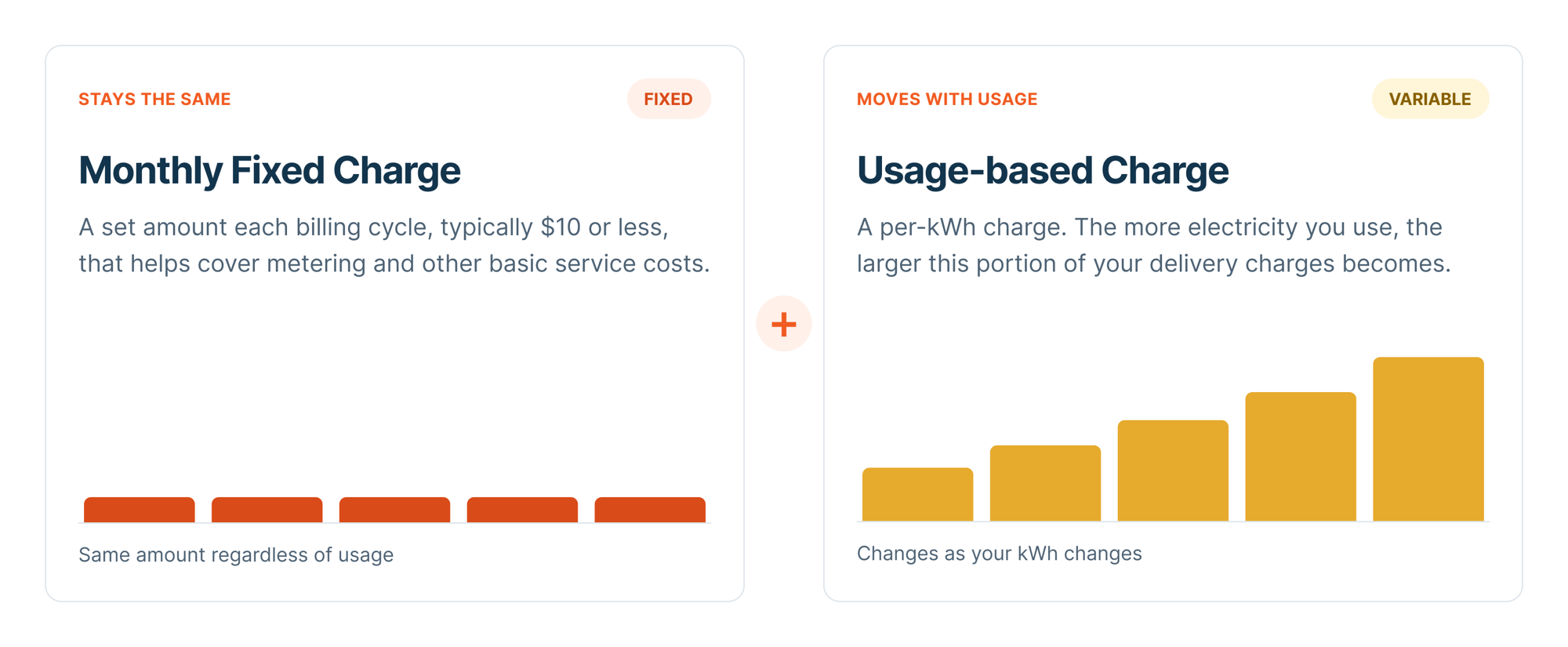
TDU charges have two parts: a fixed monthly charge and a usage-based charge. The utility sets the fixed monthly charge at its sole discretion, subject to approval by the Public Utility Commission of Texas (PUCT).
Fixed and usage-based energy charges
APG&E Sunset Wave

Why Do Two Homes Pay Different TDU Charges?

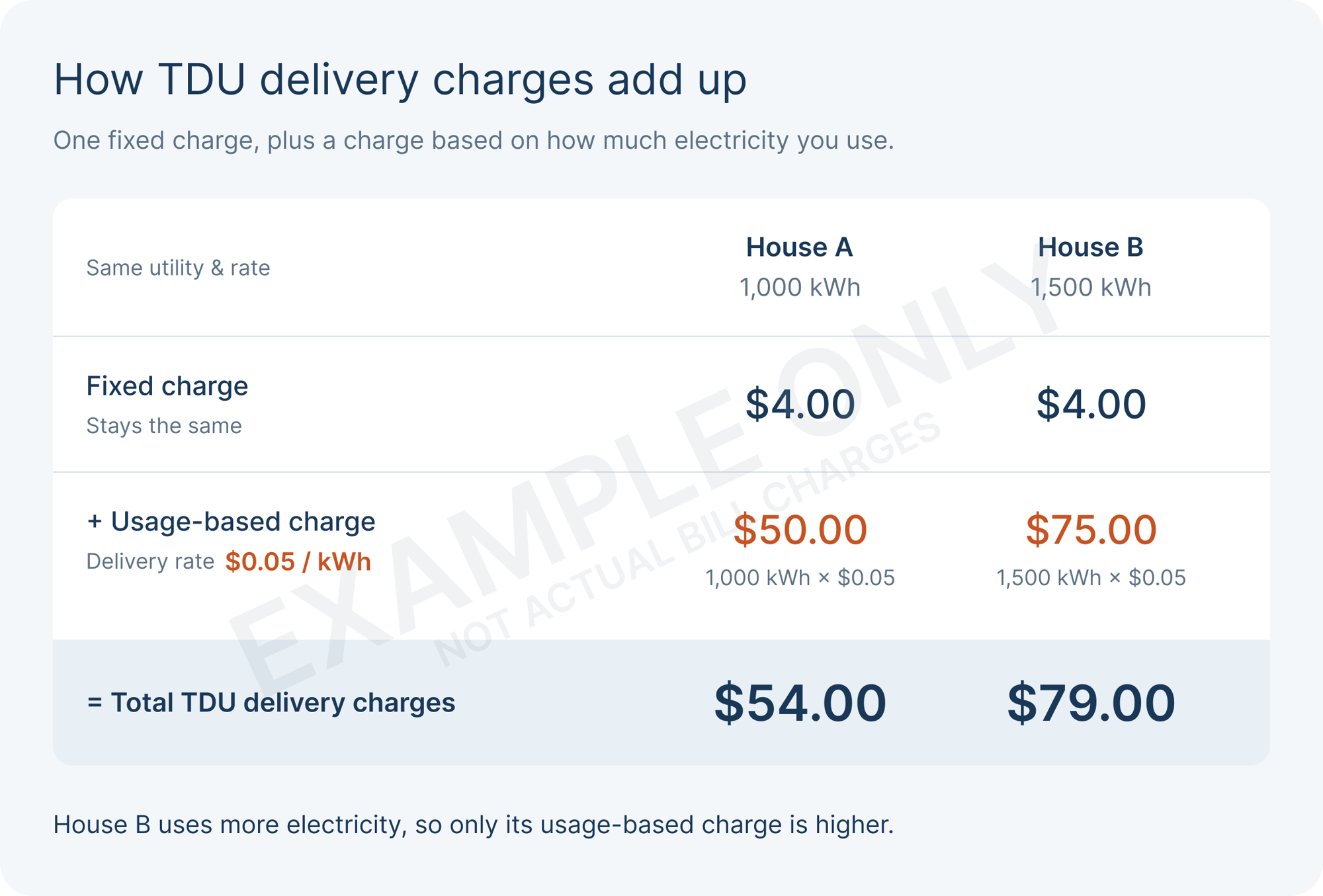
Two homes served by the same utility pay the same fixed charge, but their usage-based charges differ based on how much electricity each one uses.

TDU delivery charge example not an actual bill

Where Can You Find TDU Delivery Charges on Your Electricity Bill?

Wondering where delivery charges appear on your monthly electricity bill? Follow these three simple steps to locate your TDU charges, understand how they're listed, and see how they relate to your electricity usage.

STEP 1

Open and look for charge details

Look beyond the total amount due.

STEP 2

Find "TDU" "TDSP" or "delivery"

The exact label and naming conventions can vary.

STEP 3

Check fixed and per-kWh amounts

Compare them with your usage amounts.

UNDERSTANDING TDU DELIVERY CHARGES

Your TDU Delivery Charge Questions, Answered.

Is a TDU the same as a TDSP?

Yes. Both TDU and TDSP refer to the local delivery utility. Your retail electricity provider—like APG&E—is a different company you choose for your energy plan.

What Are TDU Charges on My Electricity Bill?

TDU charges are fees from your local Transmission and Distribution Utility (TDU) for delivering electricity to your home or business. They pay for the poles, wires, meters, and grid infrastructure in your area. You’ll see them on your APG&E bill alongside your energy charges. (TDU charges are sometimes also called TDSP charges.)

Who Sets TDU Charges?

Your local utility sets TDU charges, and the Public Utility Commission of Texas (PUCT) must approve them. APG&E doesn’t set or control these rates. We pass them through on your bill exactly as your utility charges them.

How Are TDU Charges Calculated?

TDU charges have two parts: a fixed monthly charge and a usage-based charge.

What Is the Fixed Monthly TDU Charge?

The fixed charge is the same every month, no matter how much electricity you use. It covers utility services and infrastructure costs that don’t vary with usage.

What Is the Usage-Based TDU Charge?

The usage-based charge is a per-kWh rate multiplied by the electricity you use each month. The more you use, the higher this part of your TDU charges will be.

Why Do Two Homes Pay Different TDU Charges?

Two homes served by the same utility pay the same fixed charge, but their usage-based charges differ based on how much electricity each one uses.

Does Using Less Electricity Lower My TDU Charges?

Yes. Lower usage means lower delivery costs. The per-kWh delivery rate doesn’t change, but using fewer kWh reduces the usage-based portion of your TDU charges. The fixed charge stays the same.

Are TDU Charges Different for Commercial Accounts?

Yes, they can be. Delivery charges vary by utility and customer rate class. Commercial accounts may also be subject to demand-based charges.

Will Switching Electricity Providers Lower My TDU Charges?

No. TDU charges are set by your utility and regulated by the PUCT, so you pay the same delivery rates no matter which retail electricity provider you choose. Switching providers can change your energy rate, but not your TDU charges.

Where Can I Learn More About My TDU Charges?

Your local utility publishes its current delivery rates, and the PUCT posts approved tariffs on its website.

Explore More Tips and Energy Insights

Discover helpful articles on electricity usage, energy plans, and ways to better understand your bill so you can make informed decisions about your energy needs.